The Allianz Group is one of the world’s leading insurers and asset managers, active in almost 70 countries and serving around 97 million private and corporate customers*. Allianz customers benefit from a broad range of personal and corporate insurance services, ranging from property, life and health insurance to assistance services to credit insurance and global business insurance. Allianz is one of the world’s largest investors, managing around 764 billion euros** on behalf of its insurance customers. Furthermore, our asset managers PIMCO and Allianz Global Investors manage about 2.0 trillion euros** of third-party assets. Thanks to our systematic integration of ecological and social criteria in our business processes and investment decisions, we are among the leaders in the insurance industry in the Dow Jones Sustainability Index. In 2025, over 156,000 employees achieved total business volume of 186.9 billion euros and an operating profit of 17.4 billion euros for the Group.

Allianz Social Resilience Index:
From cost-of-living crisis to AI—unveiling the dynamics of social risk
Downloads
The times they are a-changin’, wrote Bob Dylan in his classic song, capturing the enduring essence of transformation that our world has perpetually confronted. This year, the ripple effects of the ongoing cost-of-living crisis have deepened the divide between advanced economies (AEs) and emerging markets (EMs). Allianz Research’s newly published Social Resilience Index (SRI), which encompasses 12 indicators measuring economic and social vulnerabilities for 185 countries, marked a decline, amplifying the potential for social risk.
A story of economic divides: Advanced economies (AEs) vs. emerging markets (EMs)
Driven by factors such as currency depreciations, higher import bills for food and fuel as a percentage of GDP, and falling labor force participation, the gap in social resilience between AEs and EMs has widened. Denmark continues its top position in the social resilience ranking, followed closely by Finland and Switzerland. Latin America, having experienced a reduction in social risk over recent years, now ranks better than Emerging Asia. A distinctive divide is evident between net food- and fuel-importing nations, which have seen their social risk climb. Commodity-exporting countries like the UAE and Qatar made significant jumps in rankings.
A shifting landscape: Conflict, elections, and global dynamics
As we approach a packed election calendar in 2024, rising potential for conflict may amplify social risks. Such unrest can stall crucial private investments in infrastructure. With 75% of the global GDP—including the U.S., the EU, and India—gearing up for elections, countries to closely monitor include not just "hot spots" like Senegal and Ghana, but also those with hidden vulnerabilities preceding often-contested elections.
Civil engagement and the quest for greater social resilience
Looking ahead, enhancing social resilience goes beyond mere economic and redistribution policies. It embodies a push for increased civil participation and robust AI policy frameworks in order to manage potential threats like job losses and misinformation spread. Notably, countries that rank high on the Social Resilience Index, such as Denmark, Finland, Switzerland, and Iceland, also exhibit pronounced levels of civil engagement. The correlation suggests that heightened civil participation may act as a buffer against escalating social risk.
The AI paradigm: Navigating social implications
The rise of generative AI brings forth challenges and discussions around societal repercussions. Governments are gradually establishing responsive regulations to counter labor displacement risks and other potential threats to social stability. AEs, with dominant service sectors, face the challenge of matching the relentless pace of technological evolution to ensure they remain both competitive and socially cohesive.
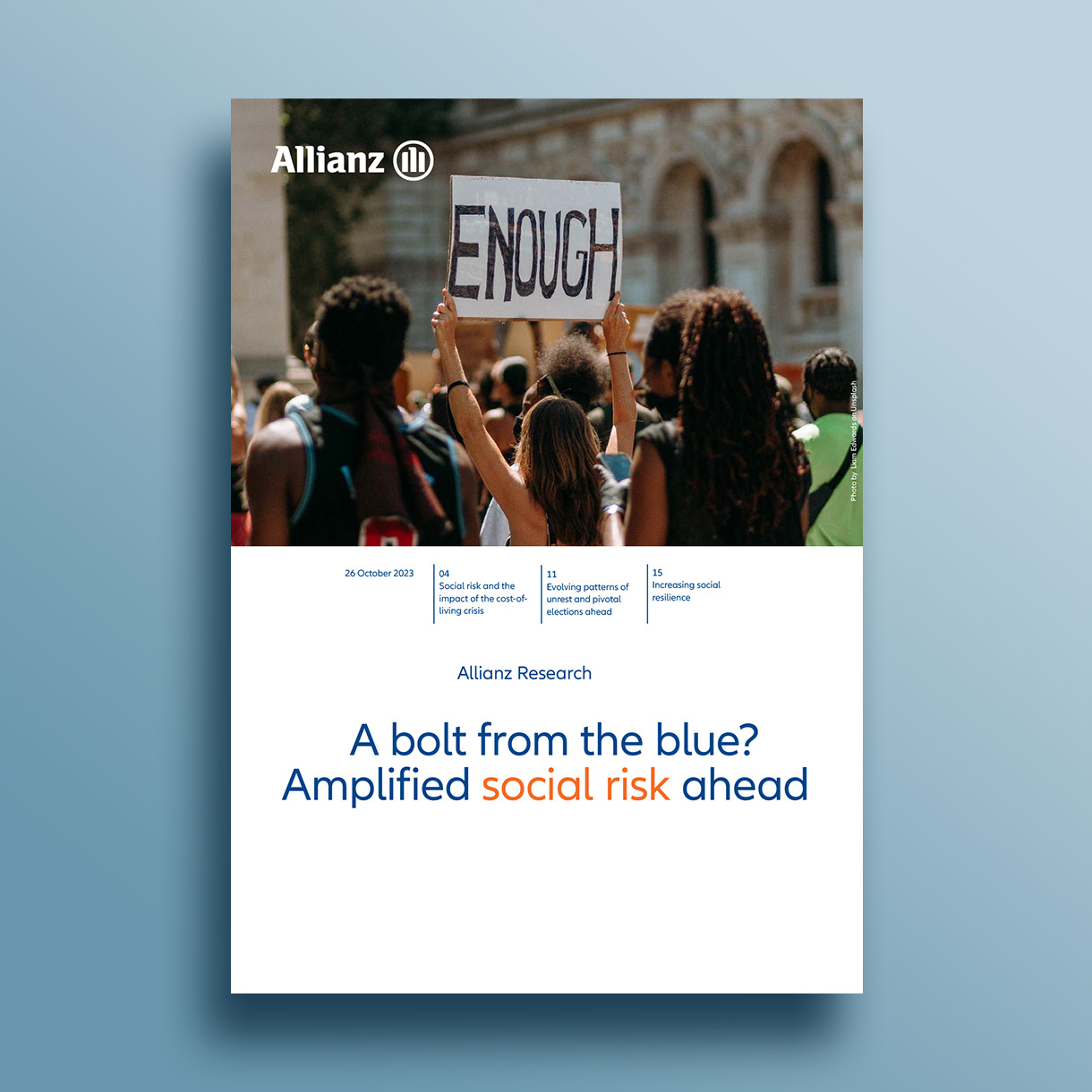
For a deep-dive into the findings of the Social Resilience Index, read the newly published Allianz Research report here
Download Report: Social Resilience Index
Related Links
Global Insolvency Outlook
Allianz Global Wealth Report 2023
About Allianz
* Customer count reflects Allianz customers in consolidated entities that are part of the customer reporting scope only.
** As of December 31, 2025.
Cautionary note regarding forward-looking statements
As with all content published on this site, these statements are subject to our cautionary note regarding forward-looking statements: