
Dr. Hans-Jörg Naumer is Head of Global Capital Markets & Thematic Research at Allianz Global Investors holding this position since 2000. In addition to numerous publications, he is the editor and (co-)author of several books, including on “Capitalism, Populism, Democracy. Or Why Populism Threatens Your Prosperity”, “wealth creation policy” and “Green Growth”.

Power of Unity
Breaking the logic of "us against them"
A specter is haunting Europe and the world: the specter of populism. It is not a new phenomenon. Rather, it can be traced back to the beginning of the 19th century and has manifested itself in various forms in Latin America as well as in Europe and the U.S. While left-wing populism, which typically dominates in Latin America, promotes the welfare state and redistribution as well as strong state intervention in the economy, right-wing populism stirs up fear of foreigners, emphasizes traditional values, and tends to advocate for deregulation and a weak state.
The political scientist Cas Mudde has reduced the ambiguous term "populism" to an "us against them" dichotomy. "Us—the true people" against "them—the elites." This makes it clear that at its core, populism is an economically driven phenomenon: it is about conflicts over distribution. According to economist John Friedman, a "zero-sum mentality" dominates: the belief that what one person gets is taken away from another. The opportunities for economic growth, which could also increase one's own prosperity, are not being seized. This also explains why very different drivers fuel populism. As populism research shows, these include globalization, technological change, migration, the global financial crisis of 2008, and even decarbonization, i.e., the fight against climate change. Interestingly, inequality only becomes a catalyst when the distribution of wealth is perceived as unfair, for example, due to a lack of social mobility.
Populism polarizes because it fuels the distribution struggle. The recent elections in the US, Europe, and Germany are a reminder of this, and the polls continue to paint the same picture.

But how can we break the logic of "us against them"?
To break the "us against them" logic, the distribution conflict must be resolved. Instead of fighting for larger pieces of a pie that remains the same size – or is even shrinking – the pieces must become larger for everyone.
Tragically, populism achieves exactly the opposite: the analysis by Funke, Schularick, and Trebesch shows very clearly that populist-led governments around the world have caused economic growth to decline since 1900. In other words, they feed on conflicts over distribution, but instead of resolving them, they exacerbate them. And not only that: they fail to deliver on all their key promises. Per capita growth, the most important indicator of prosperity, is falling, while debt and inflation are rising. Moreover, the battle for distribution against "the elites" does not lead to less income inequality. Even in the long term, the wage share remains unchanged under populist governments. There is a risk of a populist vicious circle: the intensifying distribution struggle is being fueled more and more in order to maintain power.
What's more, the noticeable losses in prosperity are continuing to affect people's own portfolios. As our calculations show, stock market performance after populists come to power is consistent with per capita growth. This means that, on average, the respective stock markets underperform in comparison to the global stock market as a whole. What is bad for growth and prosperity is ultimately also bad for capital investment.
As Acemoglu, Restrepo, and Robinson, among others, have shown, there is not only a positive correlation between democracy and economic growth, but also a causal relationship: the higher the degree of democracy, the higher the economic growth. And a cross-country comparison shows that the more democratic countries are, the more market-oriented their economies are. The circle is complete. A first step toward more growth and thus less polarization would therefore be to strengthen institutions and, with them, democracy. Trust in the law, including property rights and the separation of powers, are key institutions in this regard. But so too is competition, which prevents the concentration of power, whether in companies or in the state.
The "open society," as democracy can be described in Popper's style, needs an "open economy" (see figure), which also means being open to global trade. The "wealth of nations" (Adam Smith) is fostered by competition between nations (David Ricardo). We need more globalization, not less.
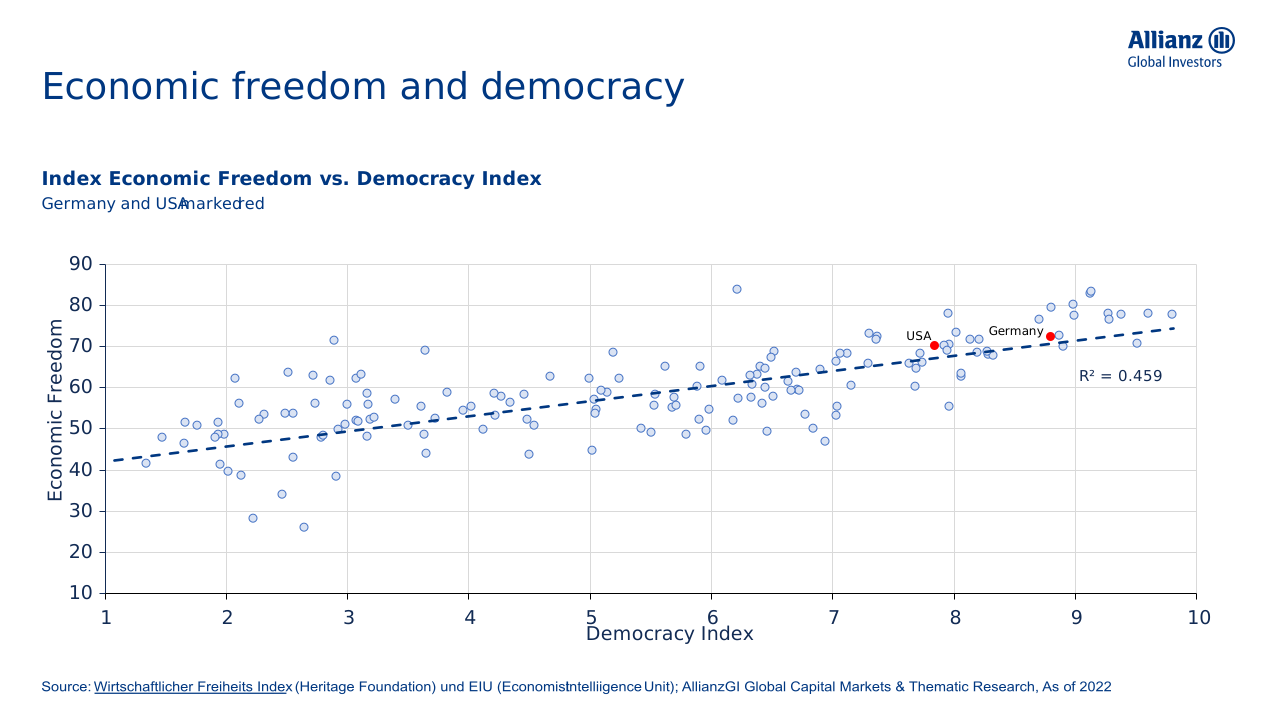
In order to break through the (fake) narratives typically used by populists, economic and financial education must also be strengthened. These are important prerequisites for participation and (political) maturity. Those who do not understand their finances can hardly be expected to invest wisely in order to build wealth and strengthen their independence. Those who are unable to think critically about basic economic issues will fall prey to (economic) political populism. This makes economic education relevant for our democracy. How can someone make a political judgment if they do not understand its economic consequences? They will fall prey to populist narratives. Economic education helps build wealth, reduce inequality, and strengthen our democracy.
Consequently, strengthening wealth creation is part of preventing populism. Prosperity must also mean "prosperity for all." "If substantial subgroups of society feel that they cannot expect any benefits from the existing social order, [ ...] then the existing democratic institutions [...] lose their legitimacy," states economist Tim Krieger. While property is a fundamental part of a market economy, the path to getting there, wealth creation, also needs to be encouraged. Private property counteracts the feeling of losing independence. This puts wealth creation policy on the agenda. As an immediate measure, it could also make sense to switch at least part of the statutory pension system to private capital accumulation. Those who build up wealth (for old age) themselves are less dependent on political processes that determine the level of pensions.
We need to break the "us against them" mentality. It's not just about strengthening our democracy, but also our prosperity. The two go hand in hand.
About Dr. Hans-Jörg Naumer
Unlock more insights!
Explore more global and local initiatives at the Power of Unity hub
Explore more global and local initiatives at the Power of Unity hub
More news



About Allianz
Last updated: September 23, 2026
The Allianz Group is one of the world’s leading insurers and asset managers, active in almost 70 countries and serving around 97 million private and corporate customers*. Our customers benefit from a broad range of personal and corporate insurance services, including property, life and health insurance, as well as assistance services, credit and global business insurance. Recognized for the seventh consecutive year as the number one global insurance brand in Interbrand’s Best Global Brands 2025 ranking, Allianz’s success is built on technology-enabled customer centricity – providing peace of mind, protection, and prevention for our customers and strengthening the resilience of individuals, communities, and societies. We are one of the world’s largest investors, managing around 791 billion euros** on behalf of our insurance customers. Furthermore, our asset managers PIMCO and Allianz Global Investors manage about 2.2 trillion euros** of third-party assets. Thanks to our systematic integration of environmental and social criteria in our business processes and investment decisions, Allianz received an MSCI ESG Rating of AAA (as of March 2026). In 2025, our 156,000 dedicated employees achieved a total business volume of 186.9 billion euros and an operating profit of 17.4 billion euros for our shareholders.
* As of December 31, 2025. Customer count reflects Allianz customers in consolidated entities that are part of the customer reporting scope only.
** As of June 30, 2026.
Cautionary note regarding forward-looking statements
As with all content published on this site, these statements are subject to our cautionary note regarding forward-looking statements: